
How it works
From discarded electronics to hands-on learning.
Every ReSpark kit follows the same six steps. Only suitable components make it through, and they’re combined with selected new parts where that’s the safer or more reliable choice.
-
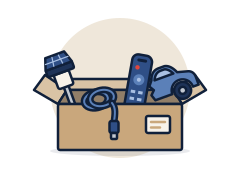
1Step one
Collect
Suitable discarded electronics are sourced.
- Broken toys, old devices and garden solar lights are the kind of items that can hold useful parts.
-
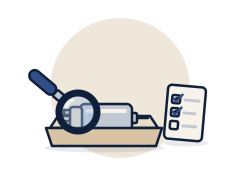
2Step two
Inspect
Components are checked for visible damage.
- Parts that are cracked, corroded or otherwise damaged go no further.
-
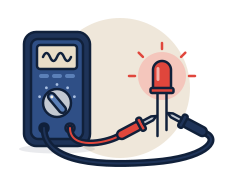
3Step three
Test
Potentially reusable components are tested.
- Only components that work as expected are considered for a kit.
-
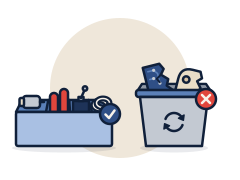
4Step four
Sort
Safe and suitable components are separated.
- Unsuitable material is set aside for appropriate e-waste channels.
- Salvaged battery cells are never included in kits.
-
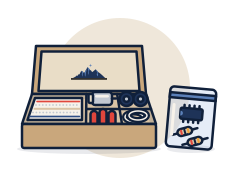
5Step five
Build
Components are combined with selected new parts to create STEM kits.
- New parts are used where they’re inexpensive, safety-critical, hard to recover reliably or unsuitable for reuse, such as breadboards, resistors and ICs.
-

6Step six
Learn
Students build projects and learn through practical experimentation.
- Circuits, motors, sensors and renewable-energy concepts, learned by doing.
Unsuitable e-waste is not placed into ReSpark kits and should be handled through appropriate e-waste channels.
Recovered + new
Honest about what’s inside.
ReSpark combines suitable recovered components with selected new components to create affordable, safe and reliable STEM kits.
Every product page lists recovered and new components separately, so you always know what you’re getting.
See it in a kit
Each kit page shows exactly which parts are recovered and which are new.